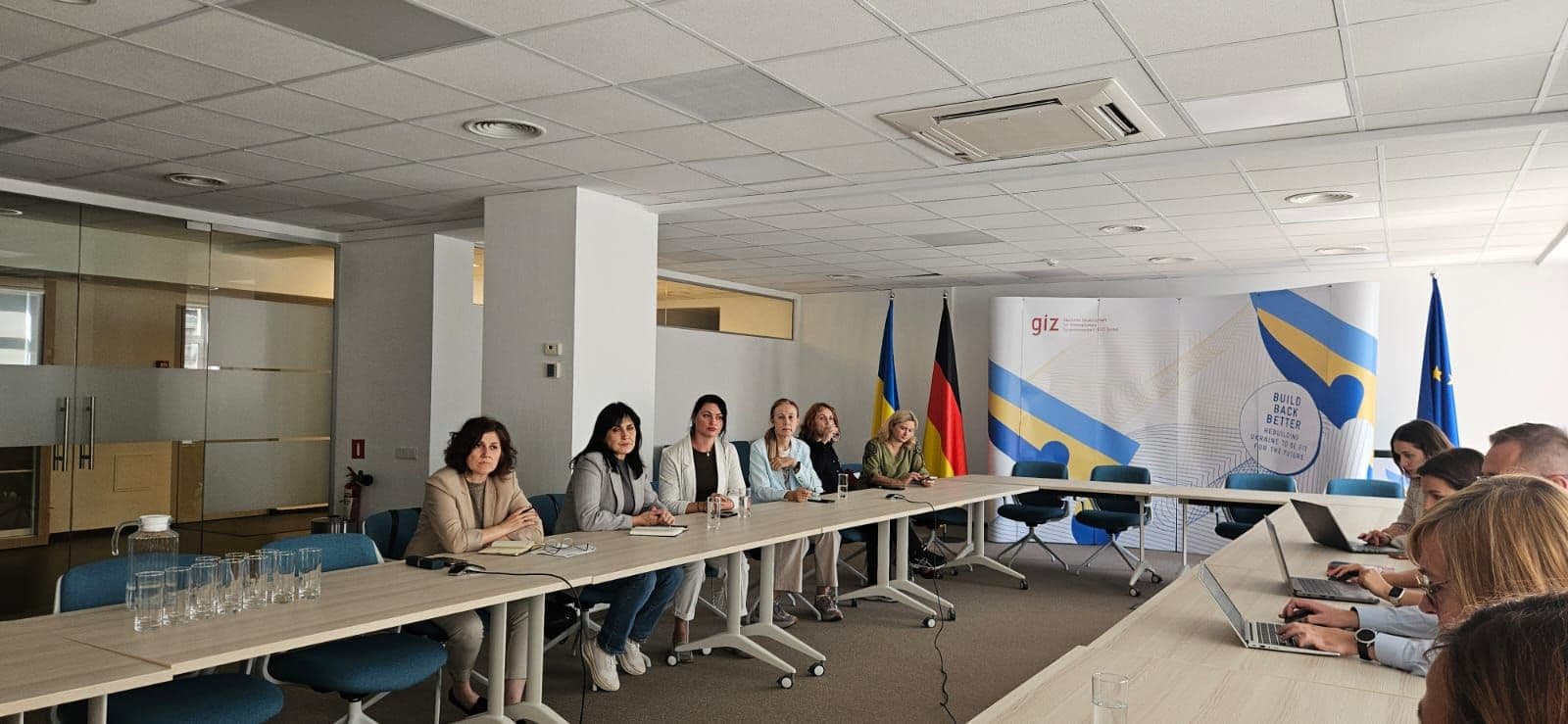
Hanna Kotenko, Chair of the Board of the Coalition of Social Service Providers, Tamara Borysova, Coalition Coordinator, and Vladyslav Zhyliaiev of Caritas Kyiv Charitable Foundation took part on 17 September 2026 in the Sectoral Dialogue «Roadmap for developing the workforce capacity of the social-services sector». Representatives of Coalition-member organisations joined online: Viacheslav Kozak (NGO «Academy of Development, Support and Social Adaptation of the Child “KIDDOM”», Kyiv) and Iryna Sarancha (NGO «Parostok», Vinnytsia).
This is the first of three meetings aimed at further cooperation and building a sectoral dialogue between education institutions, social-service providers, and the Government to develop a roadmap for equipping the social-services sector with qualified workforce. The Workforce Capacity Development Roadmap for 2026–2030 is being developed in partnership with NGO «League of Social Workers» and the Skills4Recovery programme, incorporating comments and proposals from all stakeholders.
The discussion also involved the League of Social Workers, the Ministry of Social Policy, the Ministry of Education and Science, the Ministry of Economy, and the State Employment Service. Participants discussed whether the current system of social services can meet the growing demand.
Challenges highlighted by all participants
The number of people in need of social support has grown significantly. New categories have emerged, such as veterans, family members of those killed, missing, or held captive. The social profile of communities has changed, part of the social infrastructure has been destroyed, and some communities are economically unable to provide the required volume of services. Social workers operate in very difficult conditions and need not only training but also psychological support and tools to prevent professional burnout.
According to the Ministry of Economy, the country's overall labour-force deficit is around 4 million people. At the same time, there is a significant reserve: women returning from maternity leave, people caring for relatives with disabilities, and other groups currently not working. For the social sector this means that the workforce question is not only about training new specialists but also about attracting, retraining, and returning people to work.
Community logic: an approach that has already proven effective
The Coalition emphasises an approach that has proven effective — the logic of community. This is a community of people who themselves have faced the problem and have their own experience of overcoming it.
Today, around 100 specialists in Coalition organisations previously were themselves clients of the social-services system. All of them hold higher education — particularly in «social work» or «psychology». For such specialists, short-term certification programmes are needed that make it possible to quickly acquire practical competencies and deliver simple social services. But it is equally important to create the possibility of professional growth: a person can start with basic services and gradually develop to the level of a social manager.
Hence the need to build a system of certification and professional development that recognises acquired competencies and opens career opportunities.
A separate issue concerns funding for training. Currently, training an employee in effect means diverting donor funds from direct service delivery. Mechanisms are needed that allow professional development to be financed separately from the financing of the social service itself.
A person who has themselves been through a crisis and overcome it comes into social work with a competence no classroom can provide. But today this competence is nowhere recorded — there is no document that recognises it and no step on which the person can move further. We are not talking about a privilege for former clients; we are talking about a workforce resource that is already in the system and working. The second thing that must be said aloud: when an organisation trains its employee, it is in effect taking money from the service. As long as training is financed from the same wallet as help to people, professional development will always lose. These two flows must be separated. — Hanna Kotenko, Chair of the Board of the Coalition of Social Service Providers
What has already been done and what is still missing
Elements of a continuous professional-development system are gradually appearing. The State Employment Service uses a voucher programme for vocational training in areas related to social work and care (roughly 400–500 vouchers). Eight vocational-technical education centres operate; compensation mechanisms for employers and a grant programme for setting up a business in social services are available. The Ministry of Education and Science is developing state standards for training specialists, including the profession of nanny, with expert support from the ILO. Experience from education and science, the civil service, and foreign models — in particular the Swedish professional-development platform — is being studied.
What is missing is integrity. A full-fledged system of continuous professional development in social services does not yet exist.
The main question the Coalition takes away from the meeting
How to move from separate training programmes, vouchers, grants, and projects to an integrated workforce system for the social sector — one that covers the whole process: attracting people, professional training, practice, continuous professional development, psychological support, and retaining workers in the system?
Partnership between the state, education institutions, the employment service, professional associations, employers, and civic organisations is here not an additional element but a necessary condition. The Coalition of Social Service Providers is ready to be part of this work and to share the experience of organisations that work with people every day.
The multi-donor Skills4Recovery initiative is funded by the European Union, Germany, Poland, Estonia, and Denmark. It is implemented by Deutsche Gesellschaft für Internationale Zusammenarbeit (GIZ) and Solidarity Fund PL (SFPL).