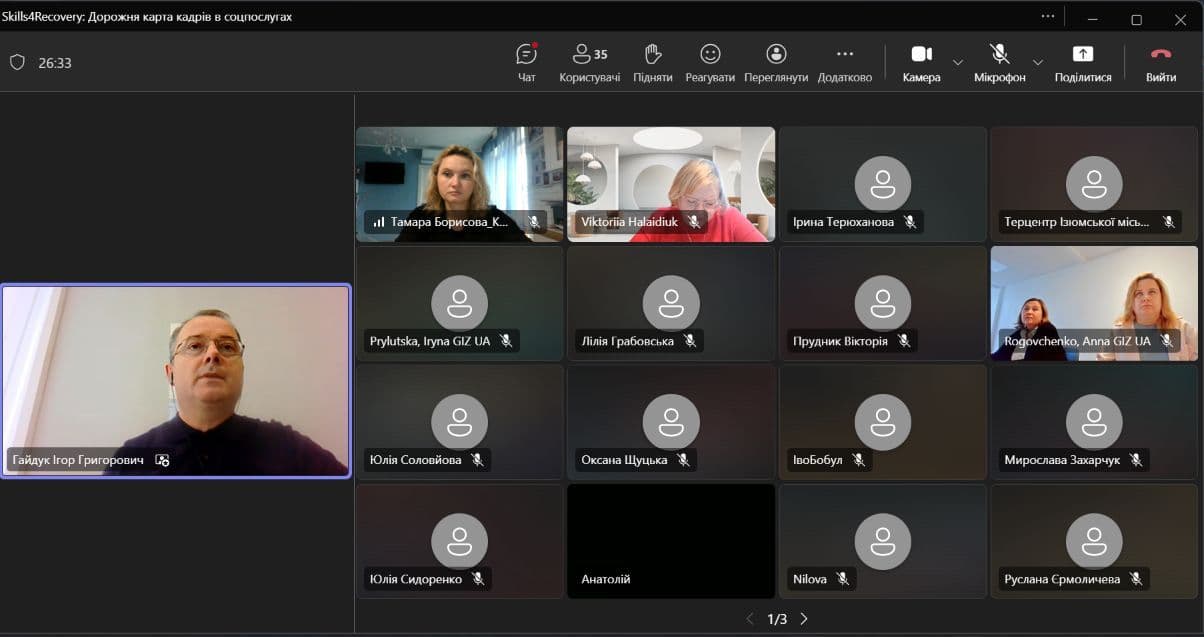
On 13 October 2026, a meeting was held within the Skills4Recovery programme «Bridging Skills for Social Services» to discuss the preparation of the Roadmap for developing the human resources capacity of Ukraine's social services sector for 2026–2030. At the event, Tamara Borysova, Coordinator of the Coalition of Social Service Providers, presented the results of a survey of civil society organisations on staffing needs, staff training, and professional learning.
The meeting took place in a hybrid format: some participants attended in person, others joined online. It was part of a wider discussion on how to attract trained specialists to social services and create conditions for their development and work in the field.
From staffing needs to systemic solutions
Participants discussed the draft Roadmap, the development of the qualifications system in Ukraine, and opportunities for cooperation between educational institutions and social service providers.
Viktoriia Halaidiuk, Deputy Chair of the Board of NGO «League of Social Workers», welcomed the participants and stressed the need to continue the sectoral dialogue in order to create a practical roadmap for workforce development.
Vasyl Fediuk, member of the National Qualifications Agency, raised the issue of increasing the number of qualification centres as the National Qualifications System develops.
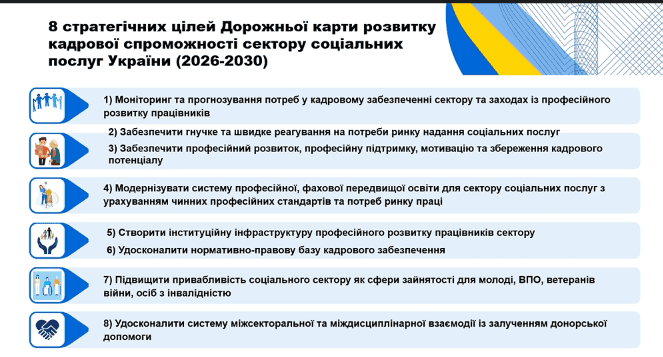
Iryna Teriukhanova, Skills4Recovery expert, presented the Roadmap for developing the workforce capacity of Ukraine's social services sector for 2026–2030. This document is meant to serve as the basis for joint action in training staff, professional learning, and human capital development.
Cooperation between educational institutions and social service providers was singled out. Tamara Borysova of the Coalition of Social Service Providers and Viktoriia Halaidiuk of NGO «League of Social Workers» shared experience of cooperation between educational institutions and the practice sector.
What the Coalition's survey showed
Presenting the survey results, Tamara Borysova focused on three topics: how organisations look for staff, what education their teams have, and who is responsible for staff professional training.
20 civil society organisations working in at least 7 oblasts of Ukraine and in Kyiv took part in the study. They include providers of home care, palliative care, support for children with disabilities, and other social services. The sample does not cover the entire sector, but the results reveal important trends among these organisations.
Staff are mostly found through personal connections. Thirteen out of twenty organisations recruit candidates through recommendations, acquaintances, or former volunteers. Eleven post vacancies, and six turn to employment centres. Only one organisation mentioned educational institutions as a recruitment channel.
Specialised education is needed, but it is in short supply. Fourteen organisations consider it important, yet their teams are usually made up of teachers, psychologists, speech therapists, and educators. Five organisations reported that their staff obtain a degree in «Social Work» while already working.
Professional training often relies on project support. Twelve organisations involve international partners and donors in training. Another six work with educational institutions. Some survey participants noted that supervision and mentoring are of great importance.
Nine organisations also named the positions that are hardest for them to fill: social workers, home-care workers, orderlies, and physical therapists.
The results showed that there is a gap between employers' needs and the staff training system. Organisations are looking for staff and educational institutions are producing specialists, but there are currently not enough working mechanisms for graduates to move from study to employment.
More on the survey results: «Social sector staffing: results of the Coalition of Social Service Providers' survey».
The solutions the Coalition proposes
Based on the survey results, the Coalition of Social Service Providers outlined several directions that should be taken into account when finalising the Roadmap:
- Strengthen cooperation between education and employers. Build partnerships between educational institutions, territorial centres, social assistance departments, and non-governmental organisations.
- Make practice lead to the profession. Give students more opportunities for paid internships, mentoring, and employment.
- Align training with the real requirements of positions. Update educational programmes in line with professional standards and the needs of the social sector.
- Support continuous professional development. Expand opportunities for training, supervision, and mentoring without limiting them to project funding alone.
- Create good working conditions for staff. Agree on pay and the cost of social services. Ensure stable employment and opportunities for career advancement.
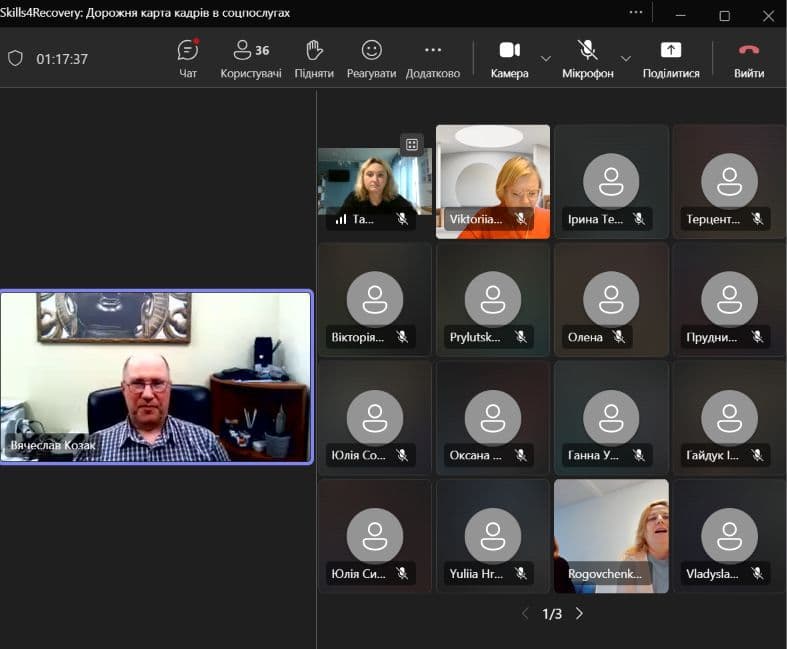
Viacheslav Kozak, member of the Board of our Coalition and President of the Network of Parents' Organisations, sees this problem from two sides — as a representative of the parent community and as a social service provider.
For many families of young people with disabilities, especially those with intellectual disabilities and autism spectrum disorders, turning eighteen means the end of support. The joint study «The Future after School» by KIIS, the DECIDE project, and the NGO «Network of Parents' Organisations» showed that career guidance for these young people relies on enthusiasts, and that communities have no systemic route from school to work. I am convinced this can be changed. Career guidance should start at school and be practical. Teenagers need job tasters, visits to real workplaces, meetings with people who are already working, and information in an easy-to-read format. Everyone needs an individual transition plan, drawn up together by the school, the inclusive resource centre, the employment centre, the family, and the young person themselves. Vocational education institutions should get assistants, trained teachers, and the ability to award partial vocational qualifications to those who need a higher level of support. Separately, we need systematic training of tutors and support specialists who will be by the young person's side from choosing a profession to their first months at work.
Supported employment can play a key role here. This social service is already provided for by the state standard and is officially called «support during employment and at the workplace». But many communities still do not provide it, and often simply do not know about it. It is needed not only by the young person but also by the employer. A support specialist helps match a position to the person's abilities, adapt the work process, prepare the team, and solve the first difficulties. That is how the main fear — «what if we can't cope?» — disappears.
At the same time, businesses need clear support from the state and communities. This means compensation for adapting workplaces that doesn't drown in paperwork, explanations of the new state standard for adapting workplaces for people with disabilities, legal advice, training for managers and mentors, and public recognition of companies that have already taken the step. Employers with this experience say they value employees with disabilities for their motivation and responsibility, and that a shorter schedule, a quieter place, and a mentor nearby are usually enough for successful work. When both the young person and the employer receive support, employment stops being the exception.
During the closing discussion, participants talked through the finalisation of the Roadmap and agreed on next steps.
The Coalition wants future decisions to take into account the experience of organisations that provide social services themselves. It also sees cooperation between education and the practice sector becoming a permanent part of staffing policy.
The workforce capacity of the social sector means the number of trained specialists, the ability to bring them into work, to provide professional support, and to create conditions for them to stay in the profession.