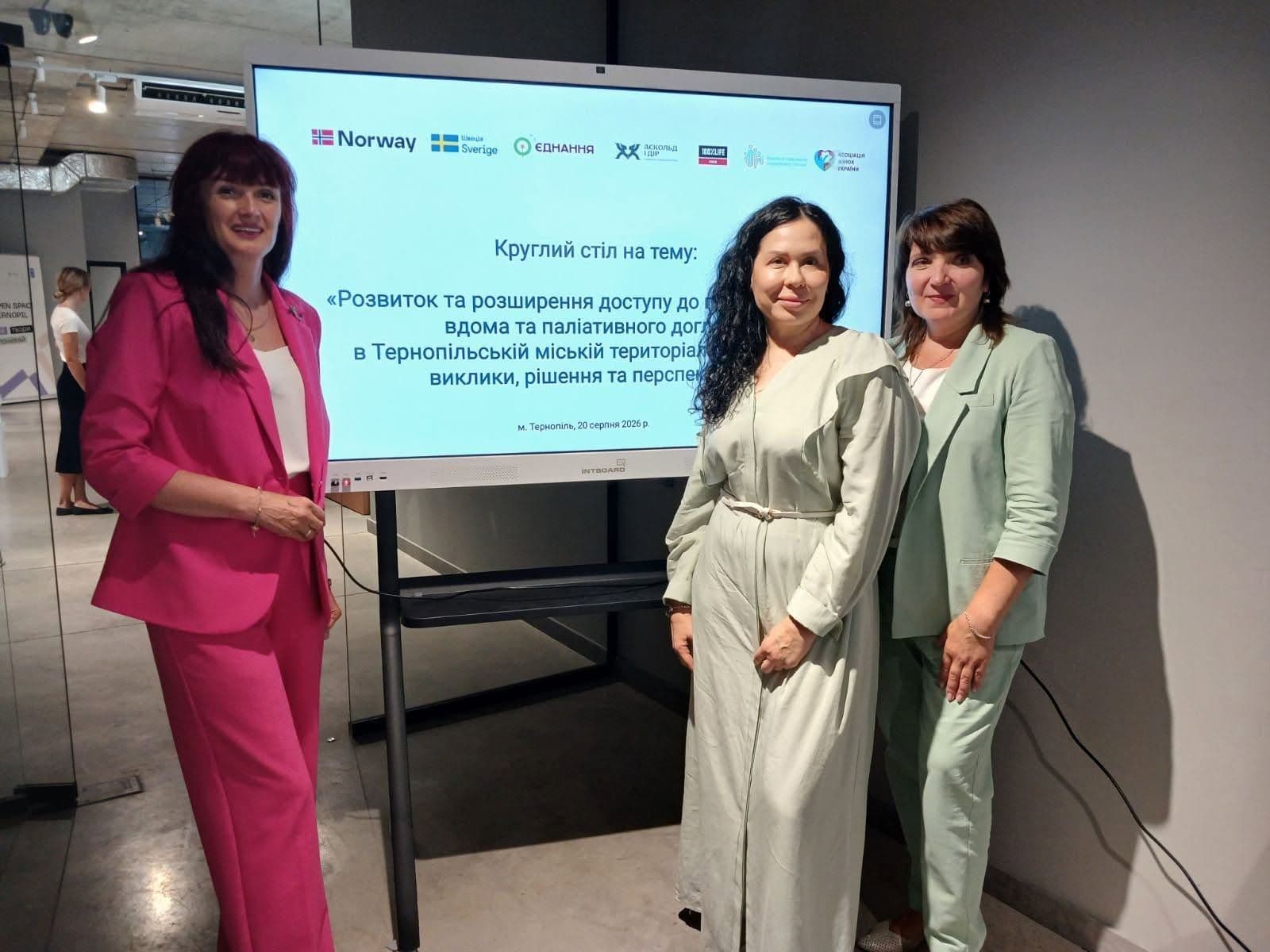
In Ternopil, NGO «Association of Women of Ukraine» hosted an expert round-table within the project «Expanding access to home care and palliative care services in 7 Ukrainian communities by a coalition of CSOs — social-service providers». The event focused on developing home care and palliative care services in the Ternopil municipal territorial community. Participants discussed the results of a community-needs study, current challenges, and concrete steps to expand residents' access to critical social services.
Participants included representatives of the Ternopil Regional Organization of the Ukrainian Red Cross Society, Caritas Charitable Foundation, NGO «IDPs of Ukraine», the Ternopil Municipal Territorial Center for Social Services, the Social Policy Department of the Ternopil City Council, the Social Protection Department of the Ternopil Regional Military Administration, and the academic community of Ternopil National Pedagogical University named after V. Hnatiuk.
During the meeting, participants discussed the results of a comprehensive study of the Ternopil community's needs and a draft Resolution containing concrete recommendations for developing the home-care and palliative-care system.
The city authorities are interested in cooperating with non-state providers and are ready to procure unique and highly scarce services, in particular palliative care.
— Vitalii Khorkavyi, Head of the Social Policy Department of the Ternopil City Council
Demand for services is growing
According to the study, more than 227,000 people live in the Ternopil community, of whom nearly 15,000 have a disability. Since the start of the full-scale war, the community has also received more than 28,000 families from other regions of Ukraine — mostly families with children and people who need additional support and care.
This has substantially increased pressure on the social sector. According to the study, the number of recipients of the «Home Care» social service in the community grew by 83.5% compared to 2024. At the same time, more than 90% of palliative patients remain without an adequate social component of care.
Larysa Rymar of NGO «Association of Women of Ukraine» and case manager and advocacy officer of the project «Expanding access to home care and palliative care services in 7 Ukrainian communities by a coalition of CSOs — social-service providers» presented the key findings of the study and stressed the scale of the problem:
In recent years, the number of people in Ukraine who need palliative care has grown substantially. Over 600,000 Ukrainians need continuous care because of incurable conditions, primarily oncological and cardiovascular. At the same time, the social component of palliative care remains underdeveloped, and families are often forced to arrange care for their loved ones on their own.
— Larysa Rymar, NGO «Association of Women of Ukraine»
These figures point to the need not only to increase the volume of services, but also to change the approaches to how they are organized and financed.
What needs to change
Among the key proposals discussed by the participants:
- improving the regulatory framework in the field of palliative and social care;
- expanding the social-procurement mechanism to bring in non-state social-service providers;
- increasing funding for care services and palliative care;
- providing for procurement of palliative care from state and local budgets;
- creating a unified information-and-coordination centre for effective cooperation between medical, social services and civil-society organizations;
- establishing a unified pathway for the palliative patient;
- developing and adopting a joint regulatory act by the Ministry of Health and the Ministry of Social Policy on the formation and operation of multidisciplinary teams that include family doctors, social workers from providers of any form of ownership, psychologists, and other specialists.
Separate attention was given to the need to regulate access to palliative care at the national level — in particular, by including the corresponding service in the list of basic social services and establishing mechanisms for financing it from the state budget.
Another important direction identified is the more active involvement of civic and charitable organizations in service delivery. Non-state providers can respond quickly to people's new needs and complement the capacity of municipal institutions.
Our task as the lead implementer of the project is not just to research community needs, but to ensure those needs are reflected in the decisions of local and national authorities. Access to home care and palliative care is a matter of dignity, quality of life, and support — not only for the patients themselves but also for their families.
— Hanna Kotenko, Executive Director of NGO «100% Life Rivne Network»
Participants of the discussion agreed that only the consolidated efforts of the authorities, the medical and social systems, the expert community, and civil-society organizations will make it possible to ensure high-quality, uninterrupted, and accessible care for those who need it.
About the project
The event took place within the project «Expanding access to home care and palliative care services in 7 Ukrainian communities by a coalition of CSOs — social-service providers», the lead implementer of which is NGO «100% Life Rivne Network».
Six member organizations of the Coalition — with many years of experience working with older people, persons with disabilities, children, internally displaced persons, and other vulnerable groups — are involved in the project. These are:
- CF «Social Assistance Service» — Kharkiv;
- NGO «Logos» — Chernihiv;
- NGO «Association of Women of Ukraine» — Ternopil;
- AUCO «Parostok» — Vinnytsia;
- NGO «Kiddom» — Shyshaky community and Pyriatyn, Poltava Oblast;
- NGO «Community Development Center “Idea. Action. Result”» — Vyzhnytsia, Chernivtsi Oblast.
The joint work of these organizations is focused on studying community needs, developing home-care and palliative-care services, strengthening the capacity of local social-protection systems, and advocating for necessary changes at the local and national levels.
In the Ternopil community, the needs assessment was carried out by NGO «Association of Women of Ukraine», the project's partner organization. Its results became the basis for expert discussion and for developing proposals to improve the palliative and home-care system.
The round-table took place within the project «Expanding access to home care and palliative care services in 7 Ukrainian communities by a coalition of CSOs — social-service providers» with the support of the Askold and Dir Fund, administered by ISAR Ednannia within the project «Strong Civil Society of Ukraine — Driver of Reforms and Democracy» with the funding of Norway and Sweden.